


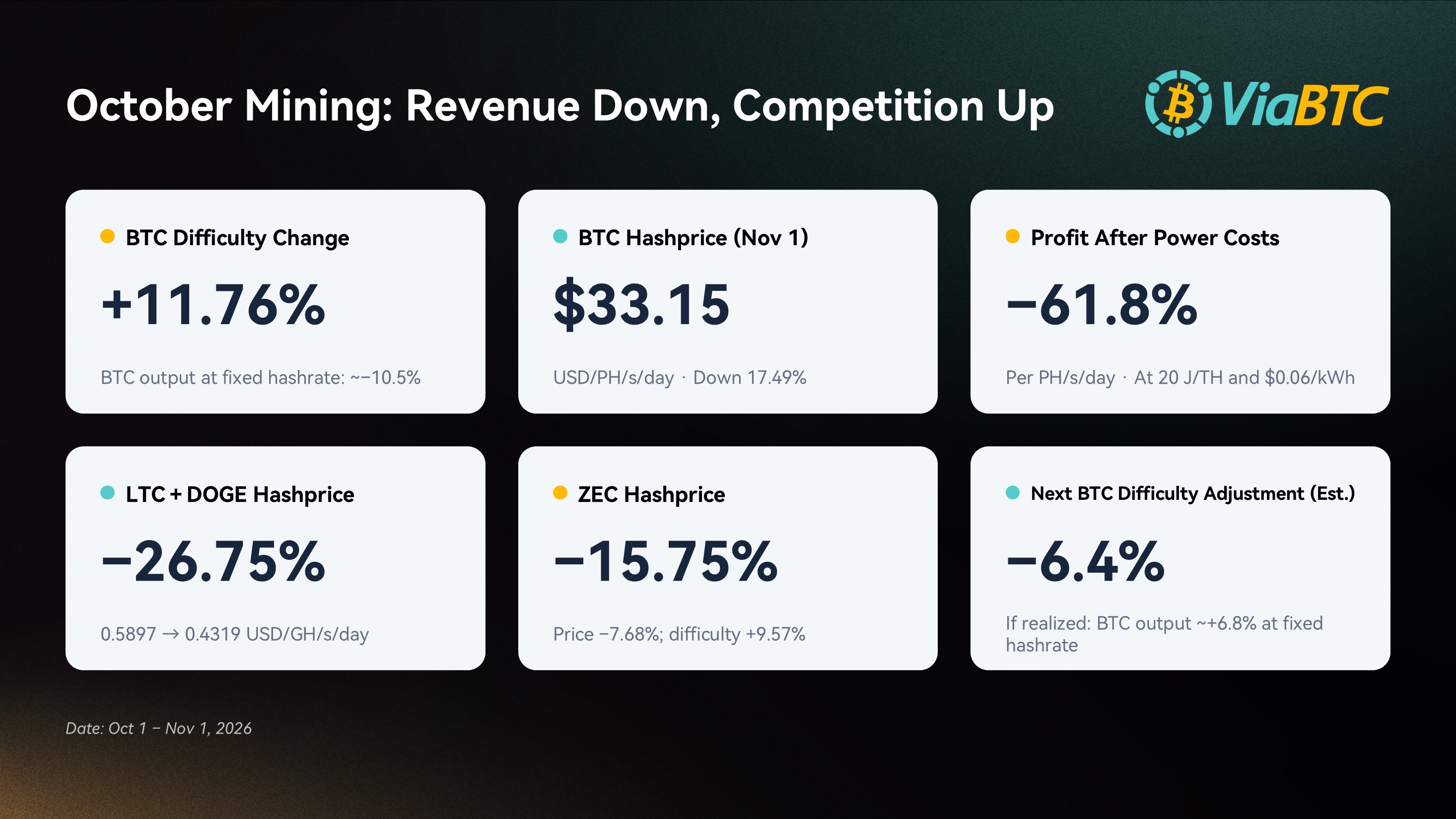
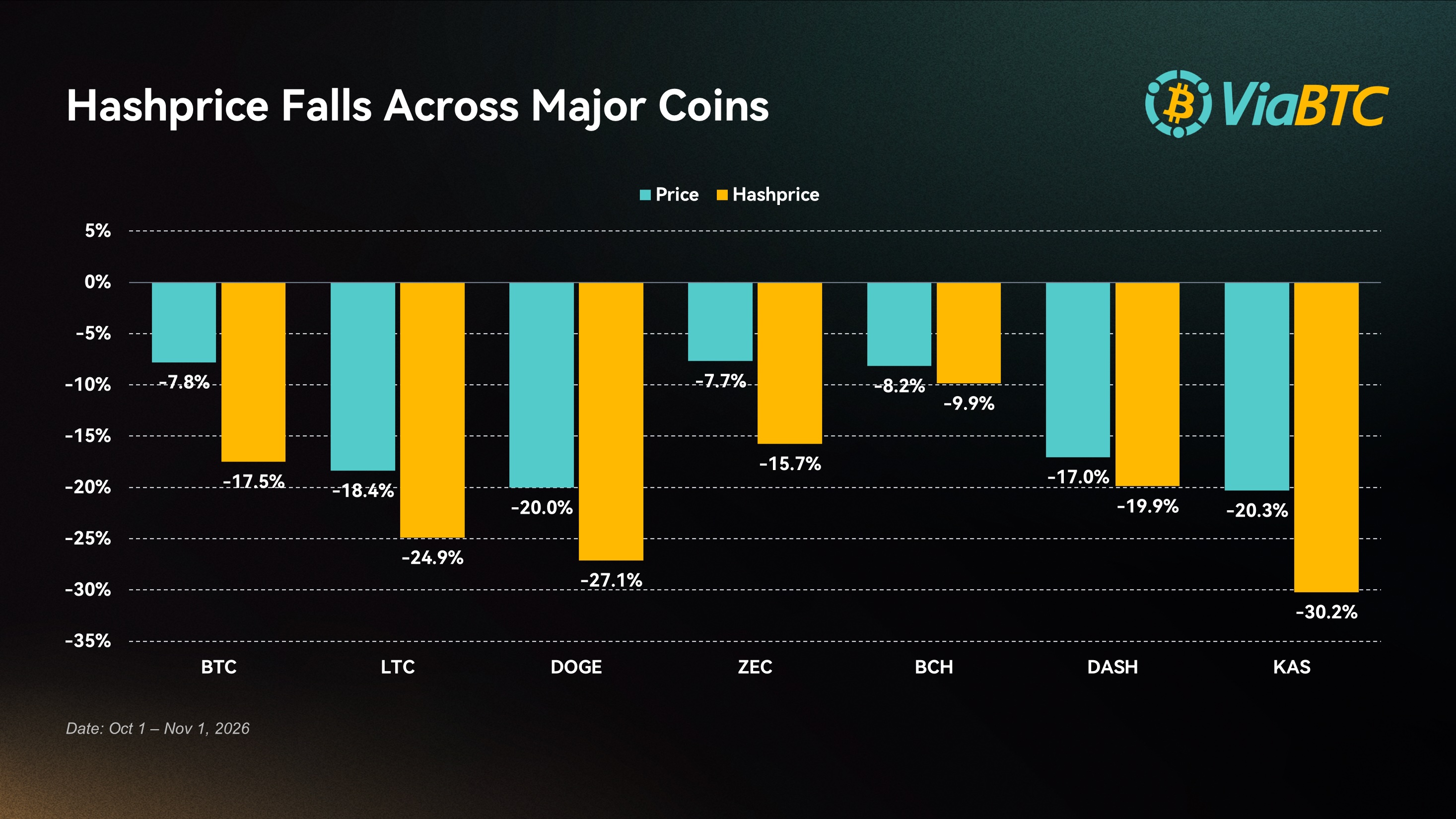
Mining revenue fell in October 2026 even as competition for block rewards intensified. Two BTC difficulty increases of more than 5% were followed by a late-month price pullback, leaving dollar revenue per unit of hashrate down approximately 17.49% from the start of October. Combined revenue from LTC and DOGE merged mining fell around 26.75%, with other major proof-of-work coins also under pressure.
Mining revenue responds quickly to price moves. Installed capacity takes longer to adjust. In Texas, some BTC hashrate returned as the summer peak-demand season ended. Institutional ZEC miners pressed ahead with equipment purchases, while operators used more flexible scheduling, automation and revenue management to keep their sites running.
Miners entered November with difficulty still above early-October levels across the major coins covered here. A BTC difficulty reduction could ease some of the pressure, but the more pressing question is whether a sustained recovery in revenue will leave miners with more cash after paying for power.
Key Metrics
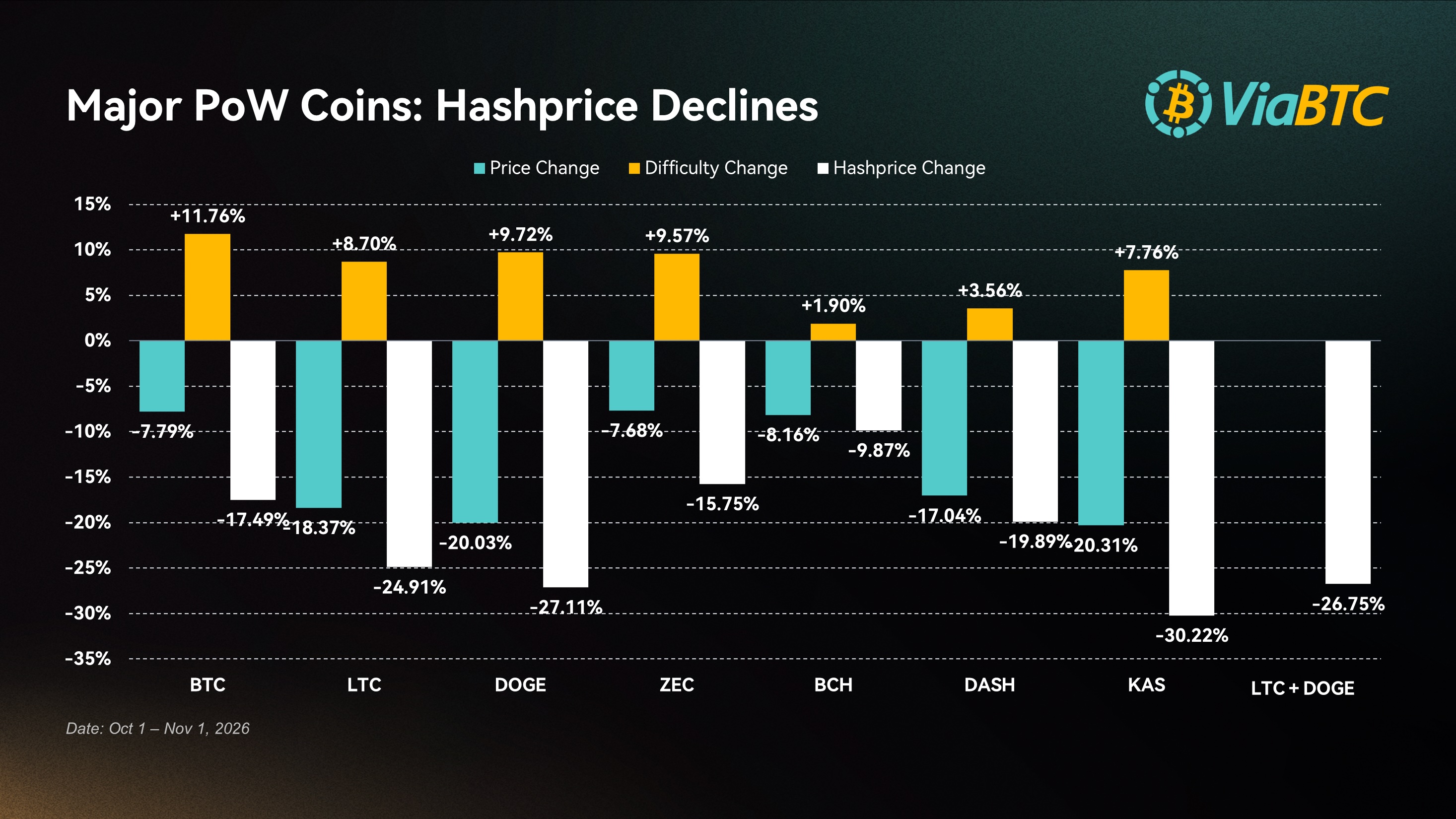
Coin | Price Change | Difficulty Change | Hashprice Change |
BTC | -7.79% | +11.76% | -17.49% |
LTC | -18.37% | +8.70% | -24.91% |
DOGE | -20.03% | +9.72% | -27.11% |
ZEC | -7.68% | +9.57% | -15.75% |
BCH | -8.16% | +1.90% | -9.87% |
DASH | -17.04% | +3.56% | -19.89% |
KAS | -20.31% | +7.76% | -30.22% |
LTC + DOGE Total | — | — | -26.75% |
BTC: Hashrate Returns as Prices Fall
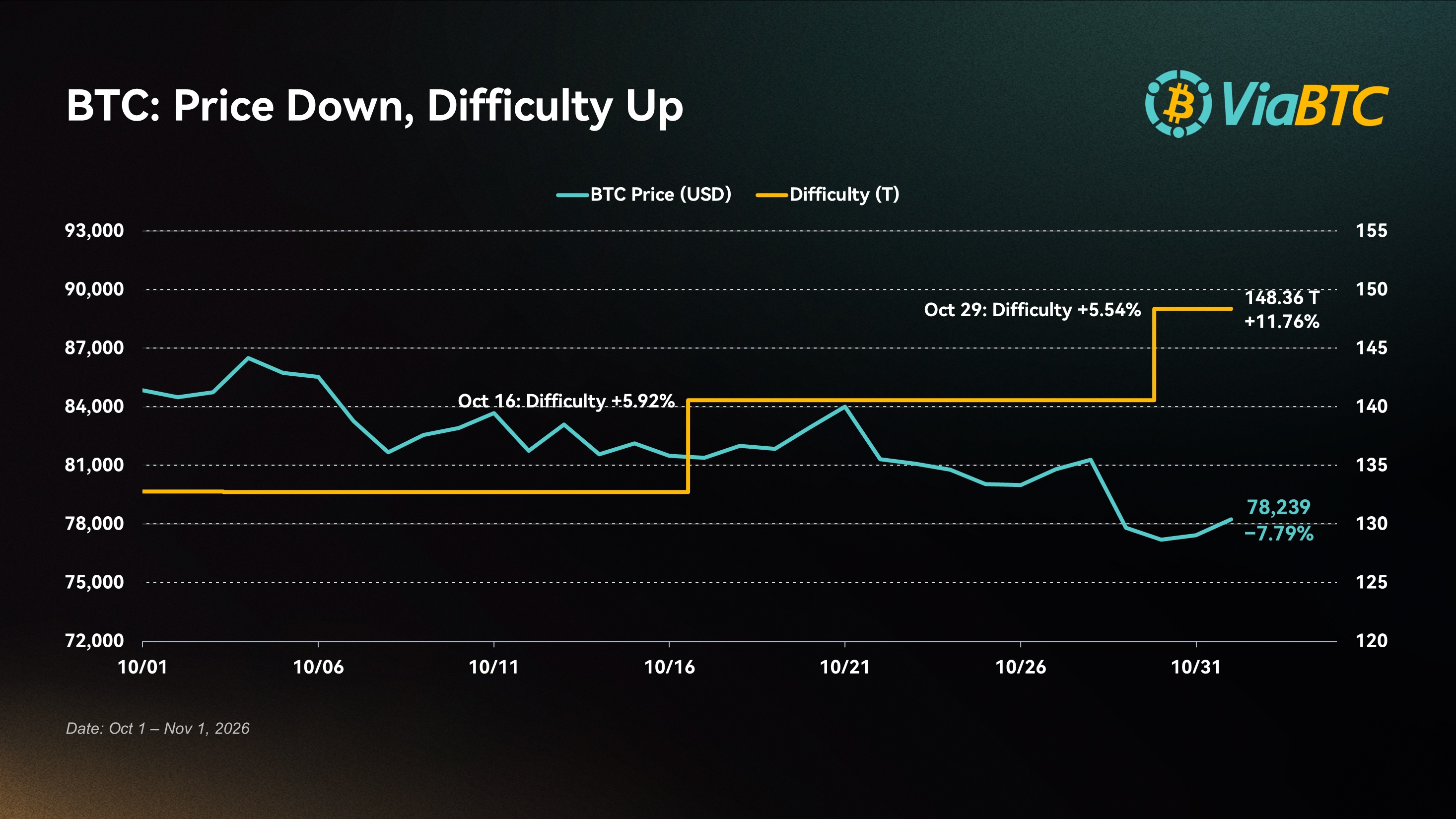
Bitcoin’s mining difficulty adjusted three times in October: it was essentially unchanged on October 3, rose approximately 5.92% on October 16, and climbed another 5.54% on October 29. By November 1, difficulty had reached 148.36 T, up 11.76% from the start of October. With no change in the block subsidy, the same amount of hashrate would now be expected to earn roughly 10.5% less BTC.
Seasonal restarts contributed to the increase. Texas miners that had curtailed operations to avoid summer peak power charges gradually brought machines back online. Across four difficulty adjustments following September’s final peak-demand period, BTC difficulty rose approximately 16.4%. These machines do not need a new price high to restart. Once operating becomes profitable again, they can return to the network and compete for block rewards.
The price then moved against miners as well. BTC fell from its October 1 close of $84,849.10 to $78,239.20 on November 1, a decline of approximately 7.79%. Hashprice, calculated using difficulty, price and the miners’ block subsidy, fell from around $40.18 to $33.15 per PH/s per day. A price drop of less than 10% had become a revenue decline of nearly 20% for the same amount of hashrate.
By month-end, even a return to BTC’s early-October price would leave miners earning less at the higher difficulty level. A price rebound would help cash flow, but higher difficulty would continue to limit how much of that recovery reached miners.
Revenue Down Nearly 20%: Operations Matter More
At 20 J/TH and $0.06/kWh, running 1 PH/s around the clock costs approximately $28.80 a day in electricity for the mining equipment. Subtracting that cost from subsidy revenue leaves about $4.35 a day in early November, down from $11.38 at the start of October—a decline of approximately 61.8%. (These figures exclude transaction-fee revenue and do not deduct auxiliary power, pool fees, operations and maintenance, depreciation or other expenses.)
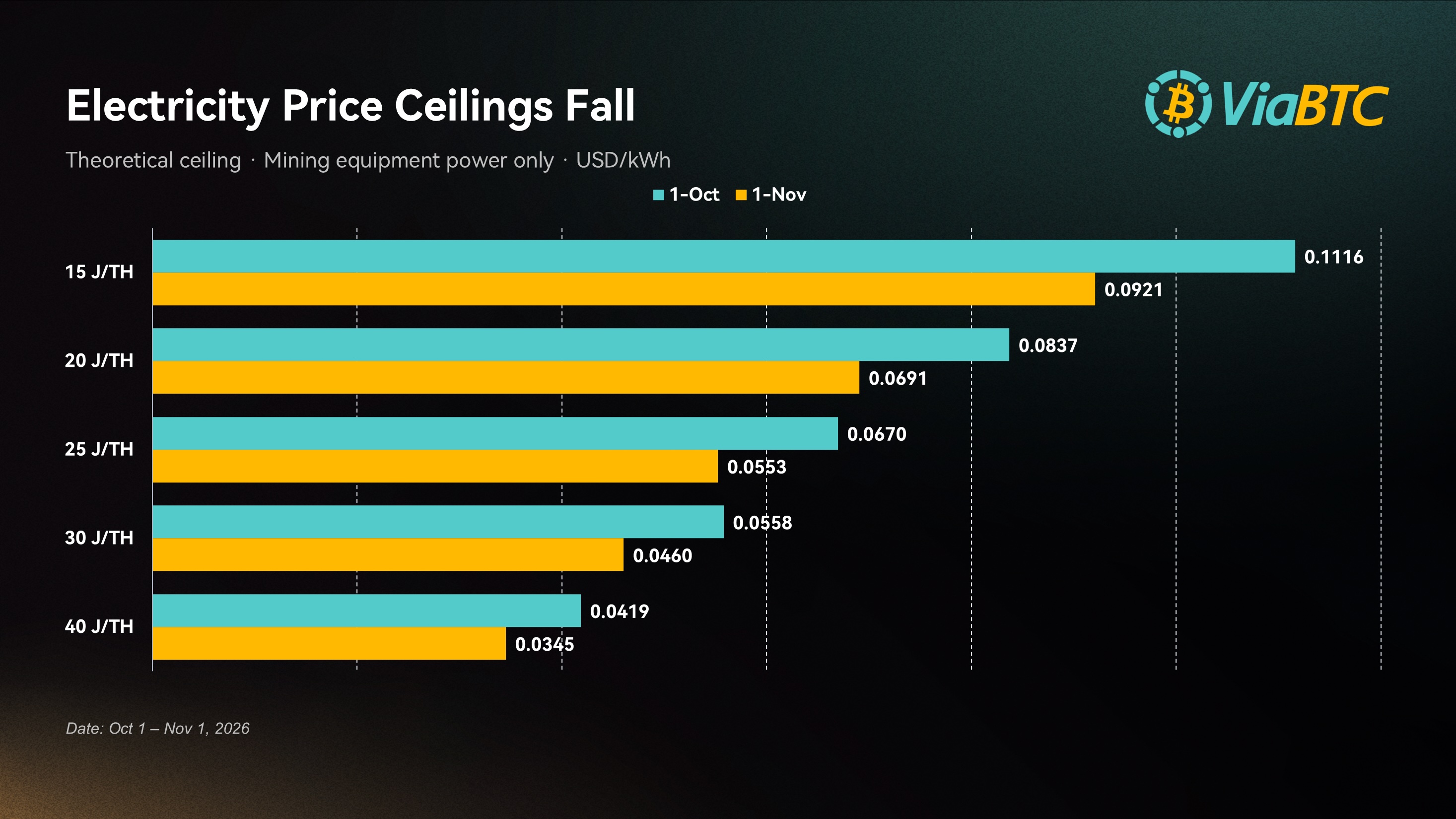
As revenue approaches the electricity bill, small differences in operating costs matter more. Less efficient machines on expensive power face shutdown first; lower-cost fleets can keep running. That is why pressure on miners does not necessarily translate into a quick decline in network competition. Even as some operators struggle, others still cover their running costs and have little reason to switch off.
Some North American operators already adjust their fleets to real-time power prices, hashprice and machine efficiency. They also sell part of their hashrate forward to lock in revenue and participate in demand-response programs. Strong markets can cover the cost of unexpected downtime, slow responses to changing power prices or poor management. With little cash left after electricity, the same losses can determine whether machines are worth keeping online. Running at full capacity around the clock may no longer deliver the best return; operators need to weigh power prices against mining revenue when deciding whether to run or curtail.
A difficulty reduction would be welcome in November. In the meantime, miners’ performance depends on more than having newer machines: it also depends on how flexibly they manage power costs and revenue.
LTC and DOGE: DOGE Still Drives Merged-Mining Revenue
Falling prices and rising difficulty pushed combined LTC and DOGE hashprice from approximately $0.5897 to $0.4319 per GH/s per day in October, a decline of around 26.75%. A Scrypt miner running the same fleet was earning more than a quarter less in dollar terms a month later.
Merged mining provides more than one source of rewards, but the revenue split is heavily skewed toward DOGE. On November 1, DOGE accounted for approximately 83.4% of the two coins’ combined subsidy revenue and around 85% of the revenue lost between the two comparison dates.
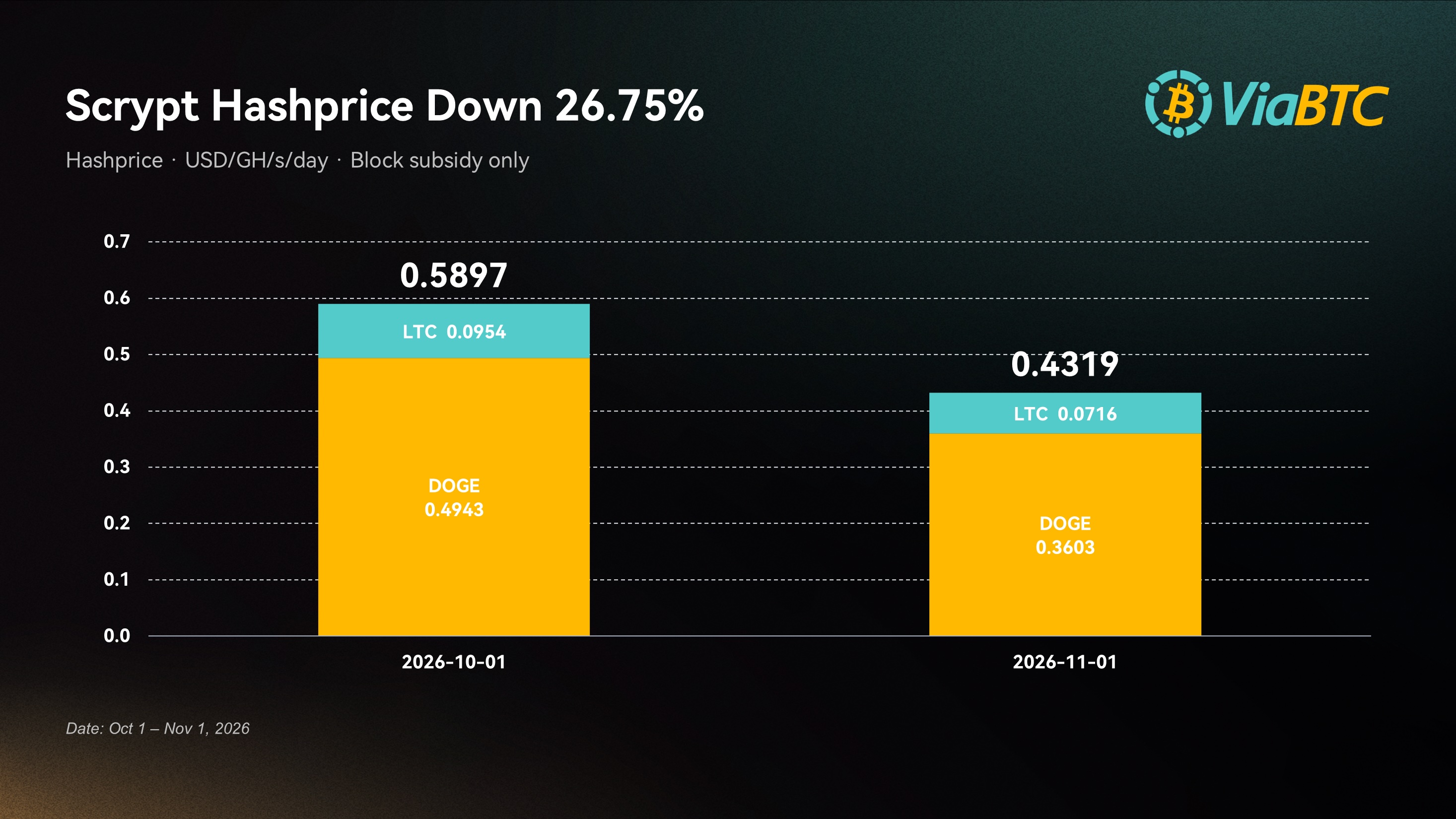
That leaves limited scope for an LTC rebound alone to lift combined revenue while DOGE remains weak. Equipment payback estimates need to account for both revenue streams.
ZEC: Institutions Keep Investing as Hashprice Falls
ZEC showed a particularly sharp divide in October. Capital-market initiatives and institutional mining investments moved forward, even as existing miners earned less per unit of hashrate.
In early October, the Winklevoss Zcash ETF filed an S-1 registration statement with the SEC, proposing to offer price exposure through direct holdings of ZEC. Fortitude also announced a priority supply allocation for BITMAIN’s next-generation Zcash miners and a non-binding purchase commitment of up to $100 million. Shipments are expected to begin in the second quarter of 2027. The announcement also noted Fortitude’s earlier order for 9,000 Z15 Pro miners.
For miners, these developments have different implications. Investment products can attract demand for ZEC; equipment purchases add future mining capacity. Institutional interest can support the asset while intensifying competition to mine it. The benefit to existing miners depends on how quickly demand grows relative to mining capacity.
October’s revenue figures already showed the strain. With ZEC’s price falling and difficulty rising, hashprice dropped approximately 15.75%—roughly twice the percentage decline in the coin’s price.
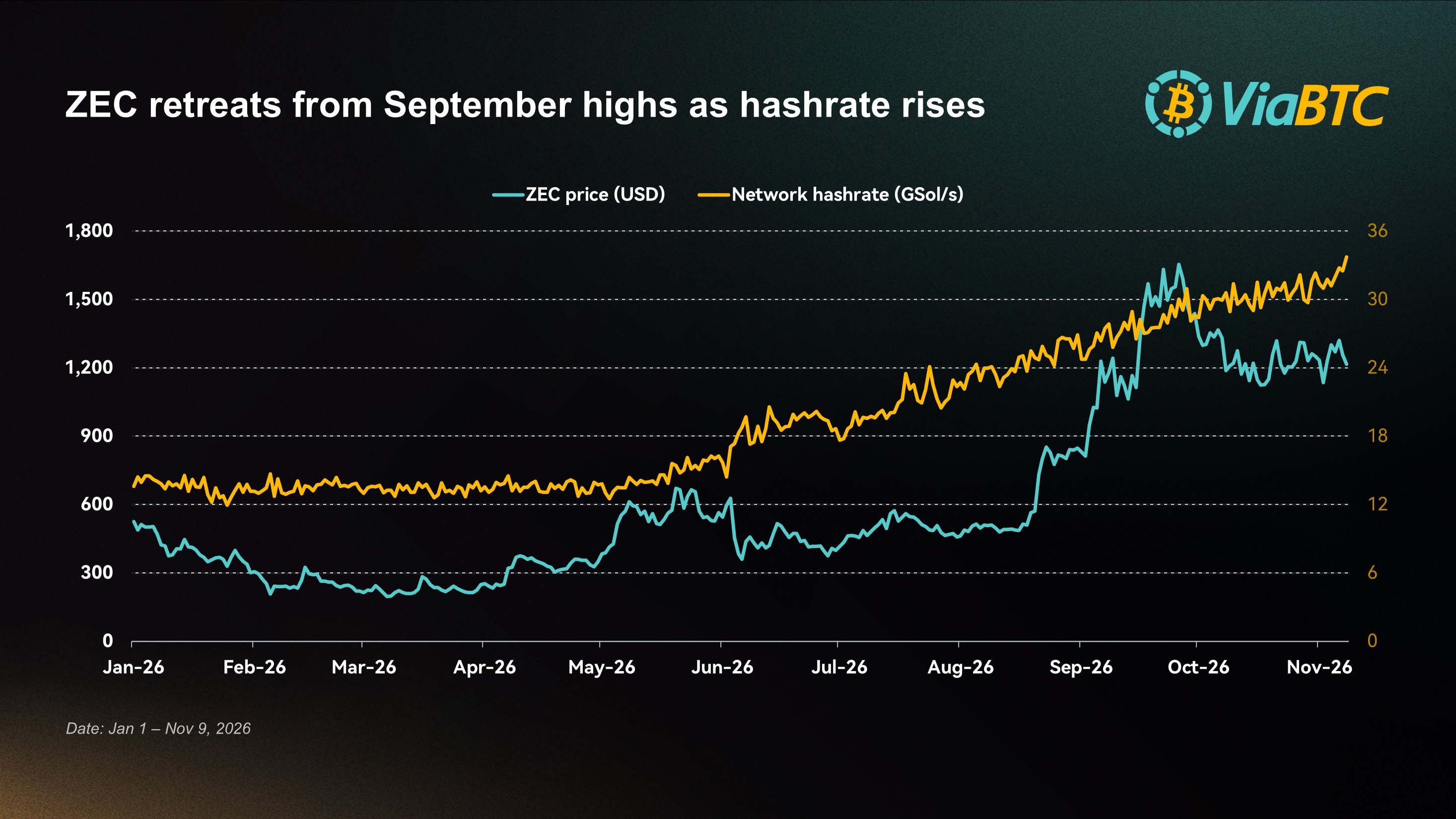
The longer-term picture is more striking. By November 8, ZEC’s price was up approximately 132% from the start of the year, while network hashrate had risen around 148%. After the September price peak, the two moved in opposite directions: the price retreated, but hashrate kept climbing. Competition steadily eroded the revenue gains from the earlier rally.
ZEC’s theoretical hashprice fell from a year-to-date high of $83.34 per MSol/s per day on September 18 to $51.94 on November 8. That was a drawdown of approximately 37.68% and around 6.48% below the $55.54 recorded at the start of the year. A recovery to $53.14 on November 9 still left it below that starting level.
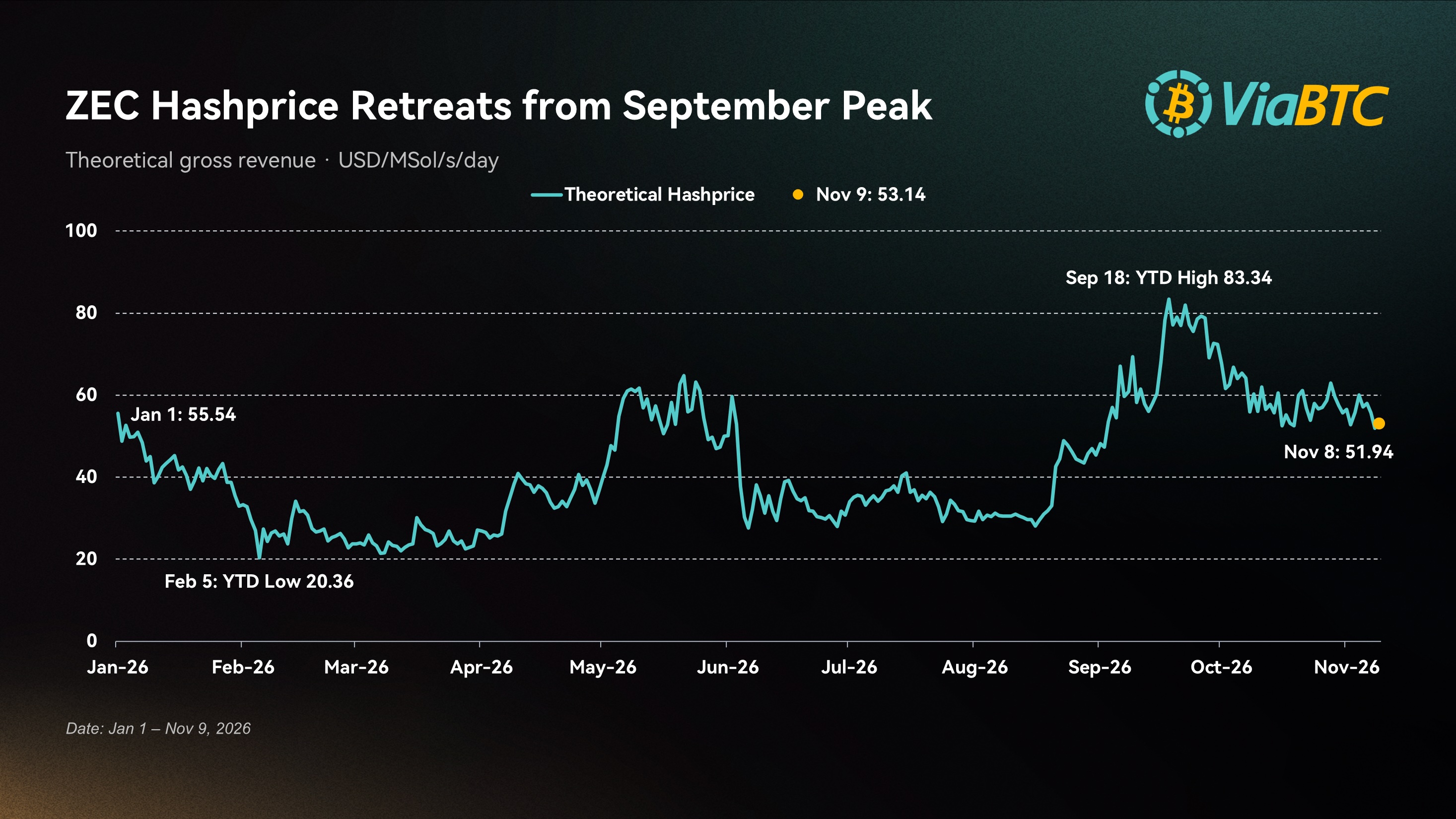
Despite ZEC’s substantial price gains since January, hashprice is now below where it began the year. Payback estimates based on the earlier high-revenue period need to be revisited. Further institutional equipment purchases could bring more machines online and add to the competition.
The Zcash Foundation released Zebra 7.0.0 with NU7 mainnet support on October 22. NU7 activated at block height 3,543,405 at 02:34 UTC on November 6, shortening the target block interval from 75 to 25 seconds. The scheduled subsidy per block fell to one-third of its previous level, leaving scheduled daily issuance unchanged. Transaction fees are split 40% to miners and 60% to the reserve. Faster blocks therefore bring no increase in daily subsidy, and the upgrade does not offset the earlier loss of mining revenue.
Other PoW Coins: KAS Also Faces Reward Cuts
BCH and DASH also faced lower prices and higher difficulty. BCH’s relatively modest difficulty increase kept its hashprice decline closer to its price decline. DASH’s deeper price correction took a larger toll on revenue.
KAS had a third source of pressure: its recurring block reward cuts. The reward fell from around 2.1827 KAS at the start of the month to 2.0602 KAS, a reduction of approximately 5.61%. Together with a lower price and higher difficulty, that gave KAS the largest hashprice decline among the coins reviewed. Even if the price recovered fully, a miner holding the same share of network hashrate would still earn less than before because of the smaller reward.
Early November: Difficulty Relief May Not Be Enough
By November 8, BTC had fallen to $74,737.90, a further 4.48% below its November 1 price. LTC and DOGE had lost another 9.95% and 8.71%, respectively. Yet BTC’s daily hashrate estimates averaged approximately 1,022.64 EH/s over November 1–8, broadly in line with the October average. Network hashrate showed little sign of contracting over that short window.
As of November 9, the next BTC difficulty adjustment was projected at approximately −6.4%. That would lift expected BTC output for the same amount of hashrate by around 6.8%, all else equal. Difficulty would still be approximately 4.6% above its early-October level, however, so the adjustment would reverse only part of the increase.
Some publicly listed miners were also making clearer progress in their shift toward AI. In November, IREN reported that AI Cloud revenue for the quarter ended September had risen to $200 million, while BTC mining revenue had fallen to $28 million.
For miners still running, a difficulty reduction would buy time. Another price decline could quickly erase the benefit. The immediate test for November is whether hashprice can stabilize on a sustained basis, allowing the cash left after power costs to recover.
Analyst View: Near-Term Volatility, Longer-Term Support
ViaBTC Chief Analyst Jeff Ko says the Democratic sweep in the US midterm elections has obviously triggered a repricing of political and regulatory risks. The S&P 500 initially rallied 1.58% on hopes that a divided government would reduce the risk of escalation with Iran, but then fell 4.36% on fears that the AI buildout will slow. That said, he notes that it is worth remembering that the market is still only around 5% below its all-time high.
In Jeff’s view, the coming gridlock is not necessarily bad for markets. Oil has fallen to around $90, and the US 10-year Treasury yield has eased to 4.85%. Historically, stocks have often done well under a divided government. When the two parties block each other, little legislation passes, and the less Washington does, the better equities tend to perform. Although the current configuration of a Republican president facing a Democratic-controlled Congress is not quite the same as the traditionally favored split-Congress scenario, he believes the market may have overreacted to the election outcome.
Jeff also thinks the AI trade is far from over. The fundamental challenge facing AI infrastructure is not a lack of demand, but rather constraints around electricity supply, permitting, and grid connectivity. In his view, the bottleneck for AI development may not be political gridlock in Washington, but growing opposition from local governments and communities to new data center projects.
Turning to crypto regulation, Jeff agrees that the election might create a less favorable political environment for the industry, with multiple crypto-friendly Republican lawmakers losing their seats. He therefore sees limited prospects for meaningful progress on crypto market structure legislation under the new Congress. That said, the Trump administration still controls the executive branch, including the SEC, CFTC, and federal banking regulators. Even if Congress is deadlocked, these agencies retain considerable authority under existing laws to clarify regulatory expectations for digital assets.
As for crypto markets, Jeff says the past week’s performance reflects a combination of three shocks: the aftermath of the Binance security incident, a deteriorating political outlook for crypto legislation, and a sharp correction in AI-related equities. Bitcoin briefly recovered above $80,000 following the election before reversing sharply to below $74,000 as of writing, temporarily slipping below its 50-week moving average. Ethereum has come under even heavier selling. ETF flows confirm the picture. Spot BTC ETFs saw about $1.28 billion in net outflows last week, and Ethereum ETFs lost another $365 million.
Jeff expects markets to stay volatile, with risks skewed to the downside until the December FOMC meeting on December 9. As he pointed out last week, on-chain mining indicators are already showing signs of stress, with Bitcoin hashprice declining even further. From a technical perspective, he would closely monitor the $73,000–$75,000 range as an immediate area of interest for BTC. Reclaiming a position above the 50-week moving average would be an important first step toward restoring market confidence. Over the longer term, if the post-election political landscape ultimately leads to lower oil prices, declining Treasury yields, and a weaker US dollar, the resulting improvement in global liquidity conditions could prove supportive of crypto markets.
October’s price declines reduced mining revenue without bringing a comparable easing in competition. Machines returned to service, while institutions prepared to expand capacity further. As miners wait for prices to recover, controlling power costs, running efficiently and keeping cash flow steady have become more important.